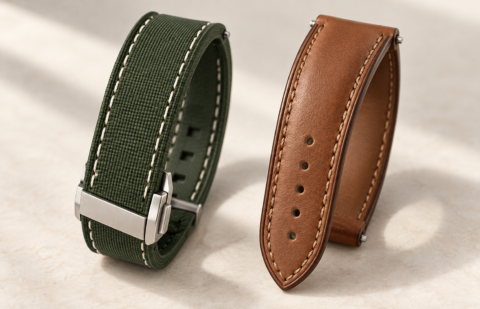
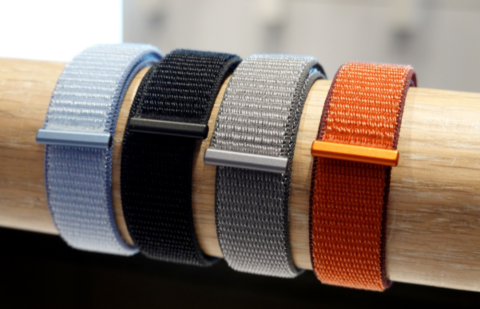






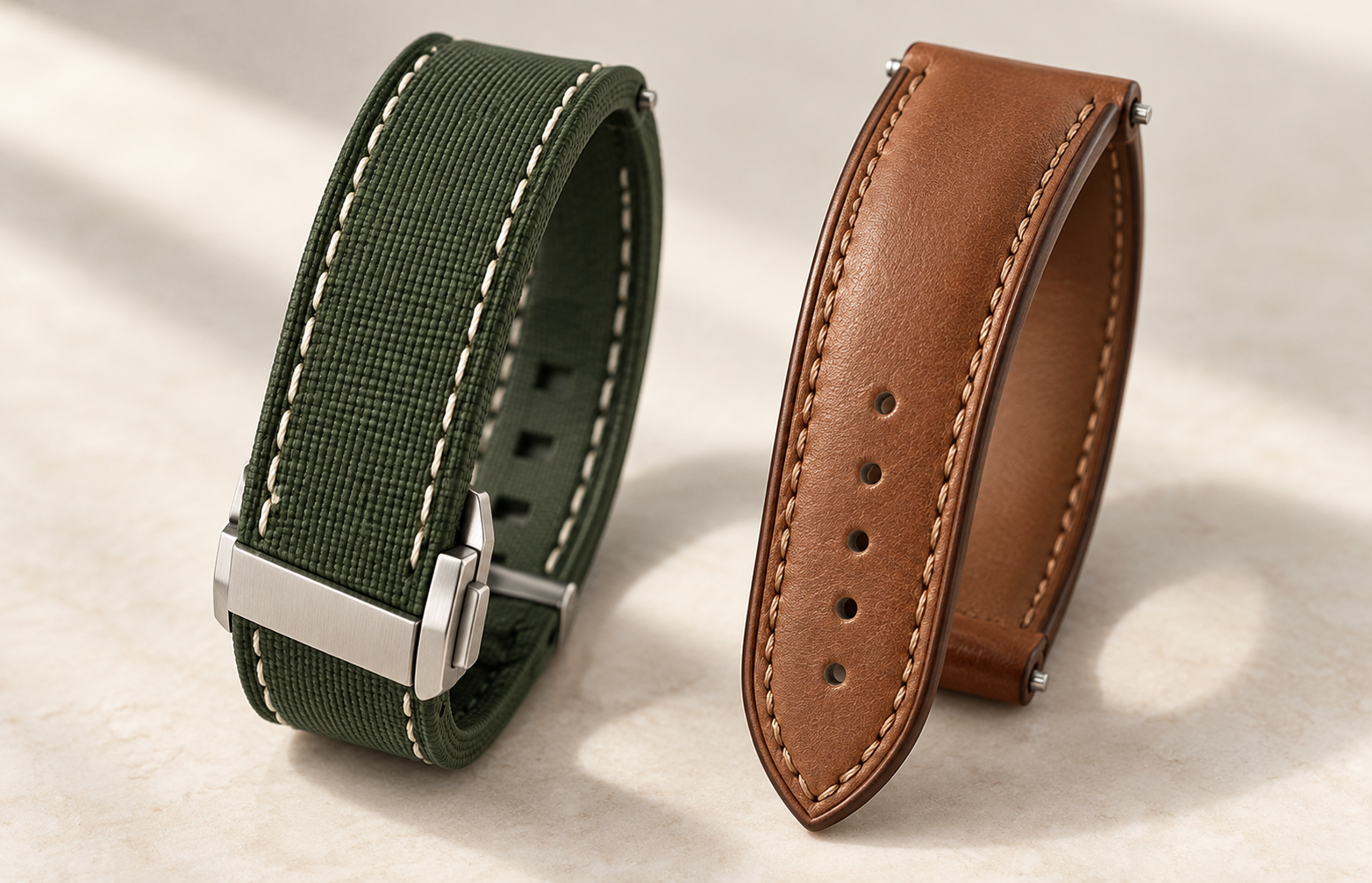
Most people who swap a watch strap for the first time pick by colour. Then the strap arrives, it doesn’t fit the lugs, or it soaks through after one hot afternoon, and the whole thing goes in a drawer. The material question comes before colour, and for most watches it comes down to leather or rubber. Both are good. They just do different jobs.
What leather does well
Leather is the traditional choice, and for good reason. A calfskin strap on a dress watch looks the way a dress watch is supposed to look. It softens with wear, picks up a bit of character over the years, and pairs with almost anything short of swimwear.
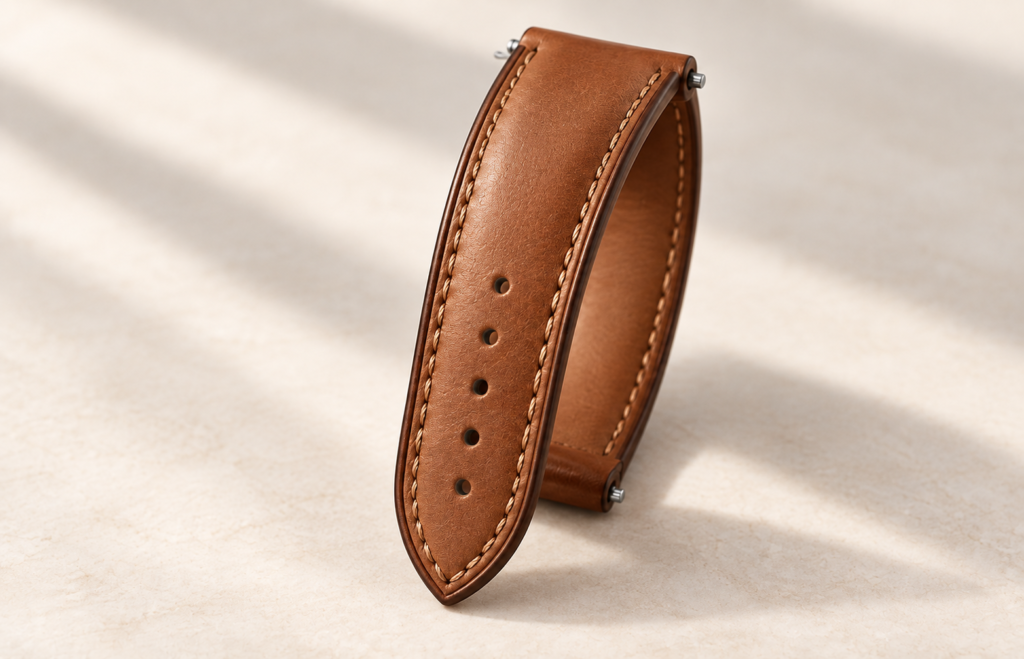
There is more variety in leather than people expect. Smooth calf is the everyday standard. Suede and nubuck are more casual and show up well on field watches. Alligator and crocodile sit at the formal end. Shell cordovan, made from horsehide, is dense, glossy and expensive, but it lasts far longer than ordinary calf.
The drawbacks are all about moisture. Sweat and water stiffen leather, discolour it, and eventually crack it. Many leather straps also need a short break-in period, so the first week can feel a little rigid. If you wear your watch through a humid summer or wash your hands twenty times a day, a leather strap will show it.
What rubber does well
Rubber shrugs off what leather can’t. Water, sweat, sunscreen, chlorine. It’s the natural fit for dive watches, sports watches, and anything you’d wear to the gym or the beach. A good rubber strap is comfortable straight out of the box with no break-in at all.
Not all rubber is equal, though. Cheap straps are usually silicone. It’s soft and inexpensive, but it attracts dust and lint, tears at the spring-bar holes, and can feel sticky against the skin. Look for FKM rubber (sometimes sold as fluoroelastomer) or vulcanised natural rubber. Both are tougher, resist heat and chemicals better, and don’t collect fluff.
The downside of rubber is that it doesn’t breathe. Trapped sweat under the strap can get uncomfortable on a long day. Straps with vents or grooves on the underside help with this. Rubber also looks wrong on some watches. A thin gold dress watch on a chunky rubber strap is a mismatch no matter how well it’s made.
Decide based on how you actually wear it
Be honest about your habits rather than your intentions. If the watch comes off before showers, swims and workouts, leather will be fine. If it stays on through all of that, buy rubber and save the leather for a second watch.
Climate matters too. Leather in a dry, cool place can last for years. The same strap in a hot, humid city might be done in a season.
Some people keep one of each and swap between them. That’s a perfectly good answer, and with quick-release spring bars it takes about thirty seconds.
Fit comes before material
Whichever way you go, the strap has to fit the watch or nothing else matters.
Start with lug width, the gap between the lugs in millimetres. Check the manufacturer’s specs or measure the old strap. A 20mm gap needs a 20mm strap. Too narrow and it wobbles; too wide and it won’t seat.
Then consider taper. A strap listed as 20/18mm is 20mm at the lugs and narrows to 18mm at the buckle. Tapered straps look more refined. Straight straps look sportier. If you plan to reuse an existing buckle or clasp, match it to the narrow end, not the lug end.
Thickness should be in proportion to the case. Thin straps disappear under a heavy diver, and thick straps overwhelm a slim case. Leather straps tend to be padded and structured; rubber straps are often thicker at the lugs and taper down toward the tail.
Finally, length. Measure your wrist where the watch sits and compare it with the maker’s sizing guide. If a buckle is closing on the first or last hole, you need a different length.
A few practical tips
Match the hardware finish to the watch. A brushed steel buckle on a polished case looks off.
If you want to swap often, quick-release spring bars are worth it. They save your lugs from tool scratches.
Deployant clasps aren’t universal. Some straps are cut for them and some aren’t, so check before ordering.
For leather, give it a day off between wears when you can. It dries out and lasts longer.
For rubber, rinse it after salt water. Even FKM appreciates it.
The short answer
Leather for looks, comfort in mild conditions, and anything formal. Rubber for water, sweat, heat and rough days. Get the dimensions right first, then choose the material that suits your life rather than the one that photographs best. A strap that fits and survives your routine will end up on your wrist far more often than the one that just looked good in the listing.