




What Makes Premium Watch Straps Worth It? A Buyer’s Guide to Luxury Straps
A luxury watch rarely stays on the strap it came with. Owners swap them for the season, for the occasion, or simply because the stock strap was the one part of the watch the brand didn’t think hard about. The trouble is that the strap market runs from a few dollars to a few hundred, and the difference between a premium watch strap and an overpriced one isn’t always visible in a product photo.
This guide covers what “premium” should mean when it’s applied to a strap, how to tell the real thing from the marketing, and where that leaves a brand like Artem Straps.
Premium starts with the material, not the price
The first marker of a luxury watch strap is that the material has been chosen for a reason the maker can explain.
In rubber, that means FKM, a fluoroelastomer that costs more than silicone or standard vulcanised rubber but doesn’t fade, go chalky in sunlight, or collect lint. Cheap rubber straps are silicone because silicone is cheap. Premium ones are FKM because it lasts.
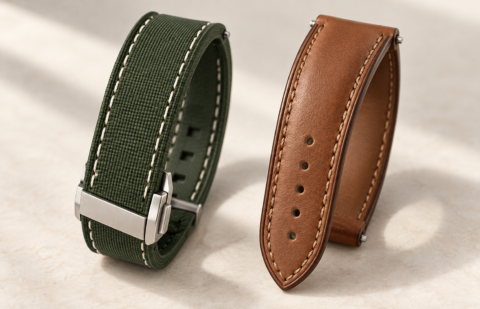
In leather, it means full-grain hide from a named tannery or tradition, finished lightly enough to develop patina. French Barenia® is the benchmark here, the same leather used by the top Paris leather houses, prized because it feels broken in on the first day and ages evenly.
In sailcloth, it means a layered construction with a real structural core rather than a printed pattern on a slab of plastic. The best sailcloth straps use an embossed upper over a leather base with a rubber or leather lining, each layer doing a job.
If a brand can’t tell you what the strap is made of beyond “rubber” or “leather,” it isn’t premium, whatever the price tag says.
It’s finished where nobody looks
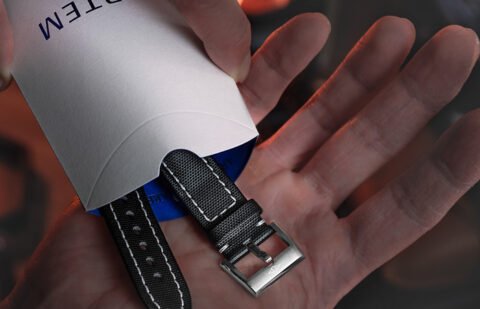
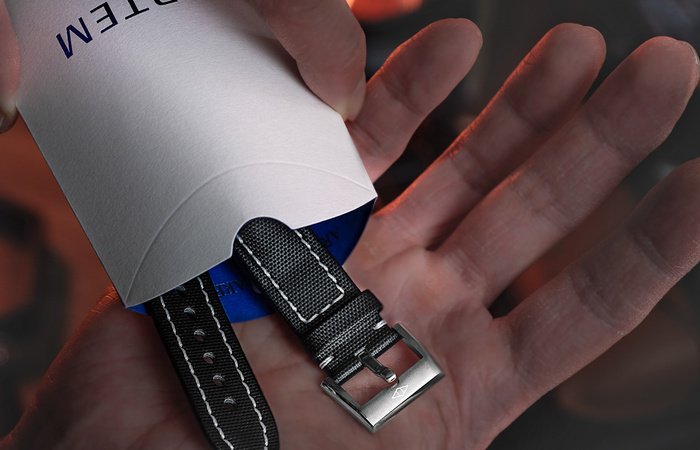
Any strap can look good from the top. Luxury watch straps are finished on the underside, the edges and the inside of the holes.
Turn a strap over. The lining should be as neat as the surface. Look at the edges: on leather they should be sealed or burnished; on rubber they should be clean and consistent with no moulding flash. Check the buckle holes, which are where most straps fail first. Some premium makers reinforce them, with a silicone strip or a bonded layer, so the tang doesn’t stretch the material over years of use.
None of this shows in a listing. All of it shows after six months on the wrist.
The hardware matches the watch
A premium strap on a stamped, hollow buckle is a waste of the strap. Good makers treat the hardware as part of the product: solid 316L stainless steel, brushed or polished to suit different case finishes, with a black DLC option for darker watches.
The better brands also offer a deployant clasp designed for the strap rather than a generic one bolted on afterwards. A proper clasp protects the strap from daily pull-through, sits flat under a cuff and makes putting the watch on a one-click job.
It fits the watch you actually own
This is where a lot of expensive straps fall short. Most come in 20mm and 22mm and nothing else. If your watch is a 19mm Explorer 36, a 21mm Submariner 41 or a 23mm Black Bay Bronze, you’re told to make do.
A luxury strap maker covers the odd sizes because the watches that use them are exactly the ones their customers own. Look for a range that runs from 18mm to 23mm, with proper tapers at each size, and with short, standard and long lengths so the clasp lands in the middle of the wrist rather than on the last hole.
It comes with a guarantee the maker can afford to offer
A two-year warranty against cracking, delamination and stitching faults is a sign the maker expects the strap to last. A thirty-day return window for fit and feel is a sign they expect you to like it. Cheap straps can’t afford either. Premium ones treat them as standard.
Why Artem Straps belongs in this conversation
Artem Straps is a useful example of what the above looks like when it’s done properly, because the brand built its name on one strap and then held every other product to the same standard.
Its HydroFlex™ rubber uses FKM that goes through a dual-stage vulcanisation process, which is why reviewers from Hodinkee, Fratello and Time+Tide have described it as the best rubber strap they’ve worn. The sailcloth line uses an embossed upper over a leather core with a natural rubber underside. The leather collection is cut from French Barenia® full-grain hide in three tonal editions.
All of it is built around the Loop-less™ system, Artem’s keeper-free design that pairs the strap with a folding clasp in stainless steel or black DLC, so there’s no loose tail and nothing to catch under a cuff. The buckles are solid 316L. The sizing runs from 18/16mm to 23/20mm. The spring bars are quick-release. Every strap carries a two-year craftsmanship warranty and a thirty-day fit-and-feel guarantee.
The brand’s motto, a Latin phrase meaning that true art hides how it was made, is a fair summary of the approach. The work is in the layers, the holes, the taper and the clasp, which is exactly where premium watch straps should be different from everything else.
Ask what the material is, specifically. Ask what the core is made of. Check whether your lug width is offered as a real size or a “close enough” one. Look at the hardware before the colour. Read the warranty.
Then wear it for a month. A luxury strap doesn’t announce itself on day one. It announces itself on day three hundred, when it still looks and feels like the strap you bought.